
Finding-to-code-and-technique map
Structured mapping of each red team finding to repository locations, ATT&CK tactic/technique, remediation approach, and validation criteria
TAC Security · Eregis ServiceBridge
Turn exercise findings into fixes with specialist-scoped remediation and follow-up validation
Coordinate specialist-scoped red team exercise support with explicit rules of engagement, authorized targets, and time windows. Implement tested remediation for findings and produce retest evidence. MITRE ATT&CK® is a reference knowledge base; it is not a certification scheme and does not imply endorsement or affiliation.
TAC assessment and Eregis implementation support are separate services. Credits fund scoped agent work; specialist support is quoted separately.
Structured mapping of each red team finding to repository locations, ATT&CK tactic/technique, remediation approach, and validation criteria
Commits/PRs with validation tests, each linked to specific red team finding IDs and ATT&CK technique IDs
Coordinated retest results from the provider including detection logic validation, prevention control verification, and response evidence
Complete evidence bundle: finding map, tested fixes, retest evidence (detection/prevention/response), and acceptance checklist for audit and compliance review
You approve the scope and authorize access. Cortex One and vetted specialists can implement changes within their assigned scopes. The assessor or independent reviewer decides the assessment outcome.
Agent grants and named professional grants are separate controls with visible expiry and revocation. No tokens exposed in UI. Access is scoped to specific repositories and branches only. Test environments and accounts per agreed rules of engagement. Repository access is required where code/configuration changes need it; agreed systems/configuration changes may need other scoped target access.
The planned steps and who is responsible for each one.
Responsible Customer
Bind the exercise scope, authorized targets, time windows, rules of engagement, and finding report. Upload the provider's assessment report.
Responsible Customer
Grant scoped read/write access to repositories containing the affected code and configurations. Separate agent grants from named professional grants with expiry.
Responsible Professional specialist
Review and categorize red team findings by MITRE ATT&CK tactic/technique, impact, and remediation complexity. Agree retest criteria with the provider.
Responsible Professional specialist
Map findings to code and configuration locations, design fixes, define validation tests, and establish evidence requirements for each finding and technique.
Responsible Cortex One
Agent and/or professional delivery implements tested changes. Each change linked to finding ID and ATT&CK technique ID.
Responsible Cortex One
Run automated validation tests and manual verification on remediated code and configurations. Collect evidence and update finding status to 'validated'.
Responsible Professional specialist
Coordinate retest with the provider. Provider performs independent retest including detection logic validation, prevention verification, and response evidence. Provider issues closure confirmation.
Responsible Customer
Assemble closure package with finding→change→test→retest chains linking ATT&CK techniques. Customer accepts. Provider confirms finding closure. Eregis does not issue red team certifications or badges.
No tools are pre-entitled.
Eligibility depends on scope, licenses, and target approval.
Specialist red team execution, reporting, and any CREST status belong to the contracted provider. MITRE ATT&CK® is a reference knowledge base; it is not a certification scheme and does not confer accreditation. Eregis coordinates implementation and evidence preparation only; does not hold CREST accreditation or control provider exercise outcomes. Professional delivery required for complex adversary techniques, detection engineering, and architectural changes. TAC Security is an offering/provider, not an accreditation body.
Maximum age: 30 days.
Revalidation New code/configuration deployment, provider retest request, or audit/compliance review cycle
Red team intake requires provider engagement confirmation, finding report, and agreed rules of engagement. Scope review required for estimator calibration.
Calibration: Scope review required
Estimator calibration pending Cortex One benchmark on red team remediation patterns. Shows 'Scope review required' until calibrated.
Evidence freshness: Freshness not yet determined
No active delivery for this service record
Tool eligibility subject to actual scope, licenses, and target approval. No purchased entitlement, running assessment, delivery, or certification claimed.
Red team exercise fees, Eregis credits, professional services, and tool licenses are each separately authorized. Buying credits does not purchase red team certification or any badge. CREST-accredited testing and any CREST marks belong to the contracted accredited provider where applicable. Provider exercise/retest inclusions and fees are defined by that separately accepted engagement, not universally included by this catalog. No numeric public price.
Engineering leads: Coordinate red team finding remediation across repositories and track retest readiness
Security teams: Manage red team exercise scope, rules of engagement, evidence collection, and provider coordination
Compliance owners: Track progress toward exercise closure with auditable evidence trails for audit requirements
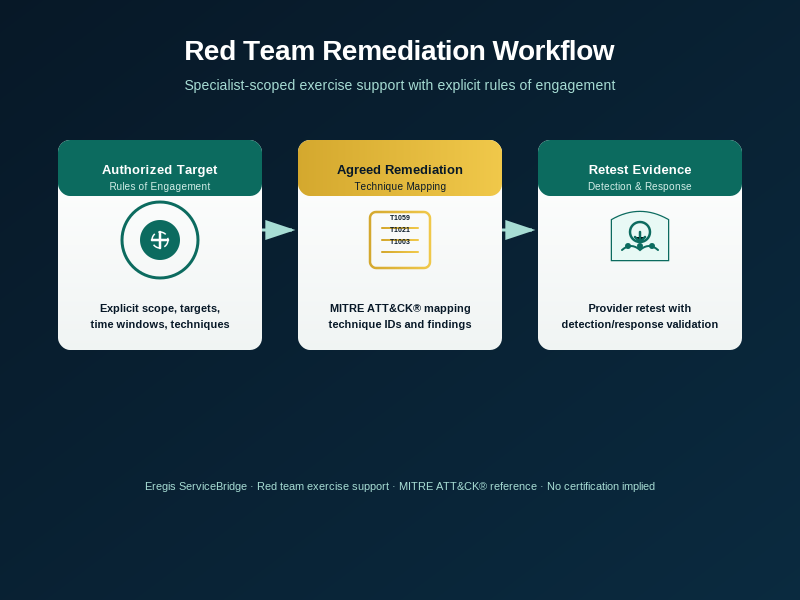
Scope and rules of engagement: Define exercise scope, authorized targets, time windows, and rules of engagement with the provider. Agree remediation and retest criteria.
Finding triage and mapping: Review red team report, categorize findings by tactic/technique/impact, map to code and configuration locations, and agree remediation approach.
Remediation planning: Design fixes for each finding, define validation tests, establish evidence requirements, and coordinate with the provider on retest expectations.
Implementation: Implement tested fixes using SuperAgent Cortex One and vetted professionals within scoped repository access; link changes to finding IDs and ATT&CK techniques.
Validation and retest coordination: Run validation tests, coordinate retest with the provider, collect retest evidence (detection, prevention, response), and update finding status.
Exercise closure: Assemble remediation evidence package with finding→change→test→retest chains linking ATT&CK techniques; customer accepts; provider confirms closure.
Agent-only: SuperAgent Cortex One executes scoped, repeatable remediation tasks
Agent + professional: SuperAgent Cortex One plus vetted specialists for complex findings
Professional-only: Vetted specialists deliver the full engagement
MITRE ATT&CK® is a reference knowledge base for tactics and techniques. We use it to map findings to standardized technique IDs for traceability. It is not a certification scheme; we do not present ATT&CK as an accreditation or badge. No affiliation or endorsement by MITRE is implied.
Agent-only mode works for well-defined, repeatable remediation tasks (e.g., configuration hardening, dependency updates, standard input validation patterns). Complex adversary techniques (lateral movement, privilege escalation chains, custom malware, detection evasion) and detection engineering require professional involvement.
Scoped read/write access to repositories containing the vulnerable code or misconfigurations. Optional read access to configuration and deployment manifests. You control expiry and can revoke at any time. No tokens exposed in the UI. Repository access is required where code/configuration changes need it; agreed systems/configuration changes may need other scoped target access.
Red team exercise fees (paid to provider), Eregis agent credits (SuperAgent execution), professional services (separately quoted), and external tool licenses (where required). Each is independently authorized. No numeric public price.
The provider who performed the original exercise performs the retest using their authorized tooling and methodology, including detection logic validation, prevention control verification, and response evidence. Eregis coordinates the retest scheduling and evidence collection but does not execute provider retest.
Finding-to-code map with ATT&CK techniques, tested fixes with validation tests, retest results from the provider (detection/prevention/response), and a closure package with acceptance checklist and technique coverage. All evidence links finding IDs to code changes, tests, and provider confirmations.
Work pauses with clear notification. Partially completed work remains visible with its evidence chain. You can purchase additional credits or adjust scope.
Yes, per the supplier agreement. Completed work up to cancellation is delivered with its evidence chain.
New findings are tracked as separate findings with their own evidence chain (finding key → proposed change → test → evidence). You review and accept before coordinating additional retest with the provider.
MITRE ATT&CK® (MITRE): Reference knowledge base for adversary tactics and techniques; use is subject to MITRE Terms of Use and copyright/branding conditions. Not a certification scheme. Branding conditions apply for reference marks. —https://attack.mitre.org/
MITRE ATT&CK Legal and Branding (MITRE): Permitted use of ATT&CK reference marks; no affiliation or endorsement implied —https://attack.mitre.org/resources/legal-and-branding/
CREST Accreditation Standards (CREST): Company and service-specific accreditation requirements for providers, including simulated attack and penetration testing services —https://www.crest-approved.org/membership/accreditation-standards/
CREST Terms of Use (CREST): Permitted use of CREST marks and accreditation references —https://www.crest-approved.org/terms-of-use/