
Asset inventory and configuration baseline
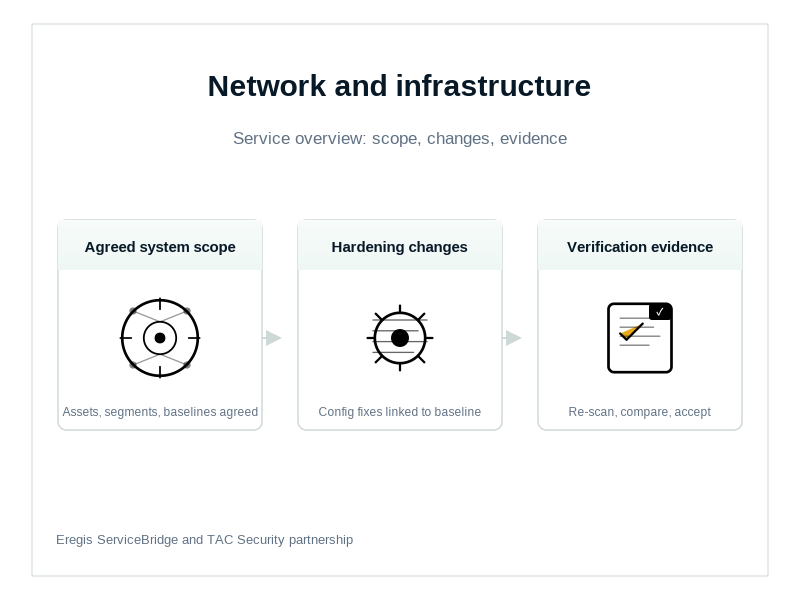
Documented inventory of in-scope network assets with agreed configuration baseline references (NIST CSF, CIS Controls)
TAC Security · Eregis ServiceBridge
Strengthen infrastructure controls with configuration fixes, hardening, and agreed verification
Identify network assets and agreed configuration baselines, implement configuration fixes and hardening, and produce reviewable verification evidence. Scope is based on assets and environments—not an application endpoint calculator. Avoids generic certification claims or unlicensed commercial control replication.
TAC assessment and Eregis implementation support are separate services. Credits fund scoped agent work; specialist support is quoted separately.
Documented inventory of in-scope network assets with agreed configuration baseline references (NIST CSF, CIS Controls)
Scanner-identified deviations from baseline categorized by severity, with remediation priority and complexity assessment
Configuration changes (device configs, IaC, firewall rules, cloud security groups) with validation evidence linked to baseline deviation IDs
Complete evidence bundle: baseline comparison, hardening changes, re-scan results, and acceptance checklist for audit and compliance review
You approve the scope and authorize access. Cortex One and vetted specialists can implement changes within their assigned scopes. The assessor or independent reviewer decides the assessment outcome.
Agent grants and named professional grants are separate controls with visible expiry and revocation. No tokens exposed in UI. Access is scoped to specific devices, cloud accounts, repositories, and branches only. Cloud costs are not included in credits.
The planned steps and who is responsible for each one.
Responsible Customer
Bind the in-scope assets, environments, and agreed configuration baseline references (NIST CSF, CIS Controls). Upload asset inventory or authorize discovery.
Responsible Customer
Grant scoped read/write access to network devices, cloud consoles, IaC repositories, and configuration management systems. Separate agent grants from named professional grants with expiry.
Responsible Cortex One
SuperAgent Cortex One discovers or validates asset inventory, maps configurations to agreed baseline references, and identifies baseline deviations.
Responsible Cortex One
Run approved infrastructure scanners against in-scope assets. Categorize gaps by severity and remediation complexity. Agree remediation scope.
Responsible Cortex One
Agent and/or professional delivery implements configuration fixes and hardening. Each change linked to baseline deviation ID and scanner finding key.
Responsible Cortex One
Run agreed verification scans on hardened infrastructure. Collect configuration evidence and update freshness status to 'fresh'.
Responsible Professional specialist
Assemble verification evidence package with baseline comparison, hardening evidence, re-scan results, and acceptance checklist. Customer reviews and accepts.
Responsible Customer
Customer accepts verification package. Independent audit or compliance review remains distinct. Eregis does not issue certification.
No tools are pre-entitled.
Eligibility depends on scope, licenses, and target approval.
No single universal program owner for network infrastructure assessment. NIST CSF and CIS Controls are reference frameworks. Eregis coordinates implementation and evidence preparation only; does not hold NIST or CIS accreditation or control independent audit outcomes. Professional delivery required for complex multi-vendor environments, legacy device configurations, and architectural changes.
Maximum age: 30 days.
Revalidation Network change, new device deployment, baseline update, or audit/compliance review cycle
Network infrastructure intake requires defined asset scope and configuration baseline agreement. Scope review required for estimator calibration.
Calibration: Scope review required
Estimator calibration pending Cortex One benchmark on infrastructure hardening patterns. Shows 'Scope review required' until calibrated.
Evidence freshness: Freshness not yet determined
No active delivery for this service record
Tool eligibility subject to actual scope, licenses, and target approval. No purchased entitlement, running assessment, delivery, or certification claimed. CIS-certified and NIST-endorsed tool claims are unavailable.
TAC assessment fees, Eregis credits, professional services, and tool licenses are each separately authorized. Buying credits does not purchase infrastructure certification. NIST and CIS references are for baseline alignment only; no endorsement implied.
Network engineers: Coordinate asset inventory, configuration baseline agreement, and hardening implementation across network segments
Security teams: Manage infrastructure scanner coordination, hardening evidence, and verification against agreed baselines
Compliance owners: Track progress toward infrastructure control requirements with auditable configuration evidence trails
Asset inventory & baseline: Identify in-scope network assets (devices, segments, cloud VPCs, firewalls, load balancers) and agree configuration baseline with the customer using NIST CSF and CIS Controls references
Configuration gap analysis: Compare current configurations against agreed baseline using approved infrastructure scanners; categorize gaps by severity and remediation complexity
Hardening implementation: Implement configuration fixes and hardening changes using SuperAgent Cortex One and vetted professionals; link changes to baseline deviation IDs and scanner finding keys
Verification & evidence: Run agreed verification scans, collect configuration evidence, and produce reviewable hardening evidence package with baseline comparison and freshness status
Agent-only: SuperAgent Cortex One executes scoped, repeatable remediation tasks
Agent + professional: SuperAgent Cortex One plus vetted specialists for complex findings
Professional-only: Vetted specialists deliver the full engagement
NIST Cybersecurity Framework (CSF) and CIS Controls are the primary reference frameworks. The specific baseline is agreed per engagement based on the in-scope assets and customer requirements. We do not replicate unlicensed commercial control sets.
Agent-only mode works for well-defined, repeatable hardening tasks (e.g., firewall rule cleanup, security group hardening, IaC configuration fixes, standard device hardening patterns). Complex multi-vendor environments, legacy device configurations requiring vendor-specific expertise, and architectural segmentation changes need professional involvement.
Scoped read/write access to network devices (via configuration management), cloud consoles (AWS/Azure/GCP), and IaC repositories. You control expiry and can revoke at any time. No tokens exposed in the UI. Cloud costs are not included in credits.
TAC assessment fees (paid to TAC), Eregis agent credits (SuperAgent execution), professional services (separately quoted), and external tool licenses (where required). Cloud costs are separate. Each is independently authorized.
No scanners are pre-entitled. Network configuration scanners, cloud security posture scanners, and firewall analyzers are eligible subject to actual scope, licenses, and target approval. CIS-certified and NIST-endorsed scanner claims are not supported—avoid endorsement implications.
No single universal program owns network infrastructure certification. Independent audit or compliance review is separate. Eregis coordinates implementation and evidence preparation only; we do not issue certification or control independent outcomes.
Each evidence item has a freshness status: fresh (validated within current 30-day window), stale (older than window), expired (window closed), or unknown. Revalidation triggers on network change, new device deployment, baseline update, or audit/compliance review cycle.
Work pauses with clear notification. Partially completed work remains visible with its evidence chain. You can purchase additional credits or adjust scope.
Yes, per the supplier agreement. Completed work up to cancellation is delivered with its evidence chain.
New gaps are tracked as separate findings with their own evidence chain (deviation ID → proposed change → validation → evidence). You review and accept before coordinating additional verification.
NIST Cybersecurity Framework (National Institute of Standards and Technology): Authoritative framework for improving critical infrastructure cybersecurity; used as configuration baseline reference —https://www.nist.gov/cyberframework
NIST Copyrights and Disclaimers (National Institute of Standards and Technology): Unmarked NIST information generally reusable with requested credits; inspect individual asset restrictions —https://www.nist.gov/copyrights-disclaimers
CIS Controls (Center for Internet Security): Prioritized safeguards for cyber defense; used as configuration baseline reference —https://www.cisecurity.org/controls/
CIS Logos and Trademark Use Policy (Center for Internet Security): CIS promotional marks require appropriate agreement; avoid unauthorized use —https://www.cisecurity.org/cis-logos-and-trademark-use-policy