
ESOF finding-to-code map
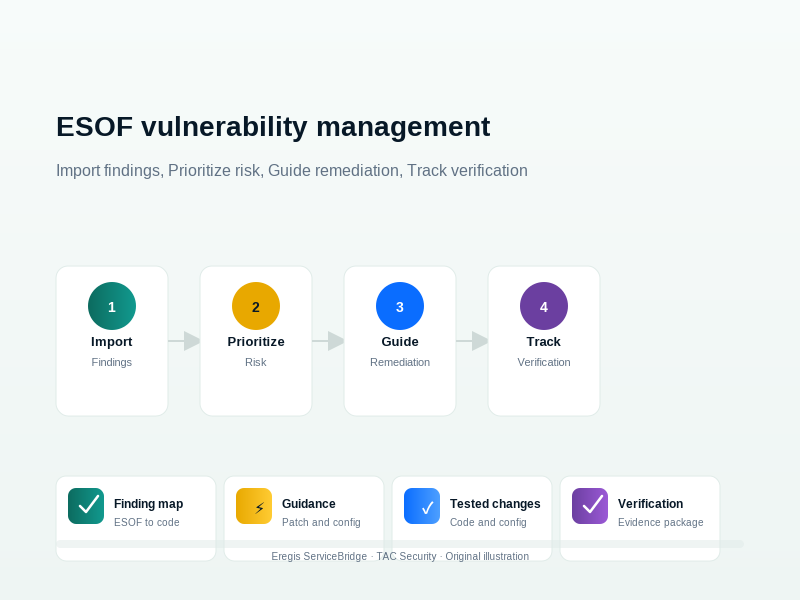
Structured mapping of imported ESOF findings to repository files, functions, and configuration locations with risk priority and remediation type
TAC Security · Eregis ServiceBridge
Prioritize findings, coordinate remediation, track verification
ESOF (Enterprise Security in One Framework) is TAC Security's vulnerability management platform that centralizes finding import, risk-based prioritization, patch and configuration guidance, and remediation tracking. This service connects your ESOF findings to scoped code remediation, validation, and evidence collection. Eregis does not provide the ESOF platform license or assessment; we coordinate implementation support for findings you bring from your ESOF environment.
TAC assessment and Eregis implementation support are separate services. Credits fund scoped agent work; specialist support is quoted separately.
Structured mapping of imported ESOF findings to repository files, functions, and configuration locations with risk priority and remediation type
Per-finding remediation recommendations: code patterns, dependency version upgrades, configuration changes, and validation test outlines
Commits/PRs with passing validation tests, each linked to specific ESOF finding IDs and risk priority
Complete evidence bundle: finding map, remediation guidance, implemented changes, test results, and freshness status for each finding
You approve the scope and authorize access. Cortex One and vetted specialists can implement changes within their assigned scopes. The assessor or independent reviewer decides the assessment outcome.
Agent grants and named professional grants are separate controls with visible expiry and revocation. No tokens exposed in UI. Access is scoped to specific repositories and branches only. ESOF platform access remains with the customer; Eregis imports findings only. Source/environment writes are required only when the accepted scope includes source changes or validation in those environments. Configuration/export review and finding import must be possible with the separately agreed evidence/target access.
The planned steps and who is responsible for each one.
Responsible Customer
Provide ESOF export or API access details. Confirm which projects, asset groups, and finding severities are in scope. Record ESOF license and entitlement status.
Responsible Customer
Grant scoped read/write access to repositories containing the affected code and configuration. Separate agent grants from named professional grants with visible expiry.
Responsible Cortex One
SuperAgent Cortex One imports ESOF findings, correlates with repository structure, and produces a finding-to-code map with risk prioritization.
Responsible Customer
Customer reviews risk-based ordering, adjusts for business context, and approves remediation scope. Configuration-only and code-change findings are separated.
Responsible Cortex One
For each finding, produce actionable guidance: code fix patterns, dependency updates, configuration hardening steps, and validation test criteria.
Responsible Cortex One
Agent and/or professional delivery implements tested changes. Each change linked to ESOF finding ID, risk priority, and validation criteria.
Responsible Cortex One
Run validation tests on remediated code and configuration. Collect evidence and update finding freshness to 'fresh' status. Link test results to finding IDs.
Responsible Professional specialist
Compile finding map, guidance, implemented changes, test results, and freshness report into a verification evidence package. Customer reviews and accepts.
Responsible Customer
Customer accepts verification package. Ongoing ESOF scans and new findings can trigger additional cycles. Eregis does not control ESOF platform, assessment schedule, or risk scoring.
No tools are pre-entitled.
Eligibility depends on scope, licenses, and target approval.
ESOF is a TAC Security product. Eregis does not hold TAC accreditation or provide ESOF licenses. Professional delivery for complex architectural remediation, legacy system constraints, or findings requiring specialized security expertise. Customer retains ESOF platform decisions and risk acceptance authority.
Maximum age: 30 days.
Revalidation New ESOF scan, new code deployment, configuration drift detection, or customer request for updated evidence
ESOF intake requires active ESOF license confirmation and findings export/API access details. Scope review required for estimator calibration.
Calibration: Scope review required
Estimator calibration pending Cortex One benchmark on ESOF finding import and remediation patterns. Shows 'Scope review required' until calibrated.
Evidence freshness: Freshness not yet determined
No active delivery for this service record
Tool eligibility subject to actual scope, licenses, and target approval. No purchased entitlement, running assessment, delivery, or certification claimed.
TAC ESOF license, Eregis agent credits, professional services, and tool licenses are each separately authorized. Buying credits does not purchase ESOF access or guarantee risk reduction. ESOF risk scoring and prioritization remain TAC's platform capability; Eregis coordinates implementation support for findings you bring.
Security teams: Import and triage ESOF findings, define remediation scope, and track verification progress across repositories
Engineering leads: Coordinate risk-prioritized fixes, link changes to ESOF finding keys, and manage agent/professional delivery
Compliance and risk owners: Maintain auditable evidence chains from finding to tested fix to acceptance decision
Finding import and triage: Import findings from your ESOF environment (CSV/API/export), map to repository locations, and apply risk-based prioritization using ESOF scores and your business context
Risk prioritization and scope: Review ESOF risk scores, CVSS, asset criticality, and exploitability to define remediation order. Separate findings requiring code changes from configuration-only fixes
Patch and configuration guidance: Generate actionable remediation guidance: code fix patterns, dependency updates, and configuration hardening steps aligned to each finding type
Remediation tracking and verification: Track each finding through proposed change, implementation, validation test, and evidence freshness. Link commits/PRs to ESOF finding IDs for traceability
Agent-only: SuperAgent Cortex One executes scoped, repeatable remediation tasks
Agent + professional: SuperAgent Cortex One plus vetted specialists for complex findings
Professional-only: Vetted specialists deliver the full engagement
ESOF stands for Enterprise Security in One Framework. It is TAC Security's vulnerability management platform that centralizes vulnerability assessment, patch management (through support), configuration assessment, and risk scoring with remediation tracking. This service connects your ESOF findings to implementation support; it does not provide the ESOF platform itself.
Yes. This service requires an active ESOF environment and access to your findings (via export or API). Eregis does not provide or resell ESOF licenses; those are obtained directly from TAC Security.
Agent-only mode works for well-defined, repeatable remediation tasks such as dependency updates, standard configuration hardening, and common code fix patterns. Complex architectural changes, legacy system constraints, and findings requiring specialized security expertise need professional involvement.
Findings can be imported via CSV/JSON export from your ESOF environment or through API access if configured. The import maps findings to your repository structure using file paths, component identifiers, and configuration keys.
ESOF platform license (paid to TAC Security), Eregis agent credits (SuperAgent execution), professional services (separately quoted), and external tool licenses (where required). Each is independently authorized. Credits do not purchase ESOF access.
No tools are pre-entitled. SAST, DAST, SCA, IaC scanning, automated validation, and code analysis are eligible for ESOF finding validation subject to actual scope, licenses, and target approval.
ESOF risk scoring and prioritization are TAC Security's platform capability. This service uses your ESOF scores as input for remediation ordering but does not modify or guarantee them. Customer retains risk acceptance decisions.
Each evidence item has a freshness status: fresh (validated within current 30-day tracking window), stale (older than window), expired (window closed), or unknown (not yet determined). Revalidation triggers on new ESOF scan, new deployment, configuration drift, or customer request.
Work pauses with clear notification. Partially completed work remains visible with its evidence chain. You can purchase additional credits or adjust scope.
Yes, per the supplier agreement. Completed work up to cancellation is delivered with its evidence chain.
ESOF - Take your vulnerability management to the next level (TAC Security): Official ESOF product landing page describing vulnerability management, patch management, configuration assessment, and risk scoring capabilities —https://landing.tacsecurity.com/take-your-vulnerability-management-to-the-next-level
TAC Security (TAC Security): TAC Security corporate website with product and service information —https://tacsecurity.com/